In This Guide
What's the Difference?
Surface & terrain
Road races run on pavement and paths: predictable footing, gentle grades, often closed city streets. Trail races run on dirt, roots, rock, gravel, snow and mud, with climbs and descents that change everything about how you move.
Navigation
Road courses are lined with barriers and marshals. Trail courses are marked with flags or ribbons, and in longer races you are expected to watch for them and sometimes carry a map or a GPX file on your watch.
Atmosphere
Big road races have crowds, music and thousands of runners. Trail races are smaller and quieter: a start in a parking lot, a few hundred runners, and long stretches on your own in the woods.
Community
Both are friendly, but trail racing has a famously relaxed culture - runners chat on the climbs, stop to help each other, and stay at the finish for food and stories.
Pace & Performance
On the road, pace is the measure: you can plan kilometre splits and compare times from race to race. On trails, pace can vary by minutes per kilometre between a flat section and a steep climb, so effort and time on feet matter more. A 25 km mountain race can take longer than a road half marathon, and trail finishing times are hard to compare from course to course.
Gear Differences
Shoes
Road shoes are light and cushioned for smooth surfaces. Trail shoes have grippier lugs, tougher uppers and often a rock plate. On packed gravel paths road shoes are fine; on technical, wet or snowy trails, trail shoes make a real difference.
Hydration
Road races have aid stations every few kilometres. Trail races space them further apart, and longer ones often require you to carry water (a hydration vest or handheld bottles) and a minimum amount of gear.
Navigation & safety
Mandatory gear lists are common on longer trail races: a waterproof jacket, a whistle, an emergency blanket, a phone. In mountain races the weather can change fast at altitude, even in summer.
Wildlife and the backcountry
Many Canadian trail races run in bear country; organisers will brief you, and some recommend bear spray or running in groups. Ticks are common in long grass in spring and fall. Carry what the organiser asks for, and check yourself after the race.
Headlamps
Ultras that start before dawn or run overnight need a headlamp with spare batteries.
The Road Racing Scene in Canada
Tamarack Ottawa Race Weekend
The country's biggest running weekend, in late May, with a marathon, half, 10K and 5K past Parliament and along the Rideau Canal.
TCS Toronto Waterfront Marathon
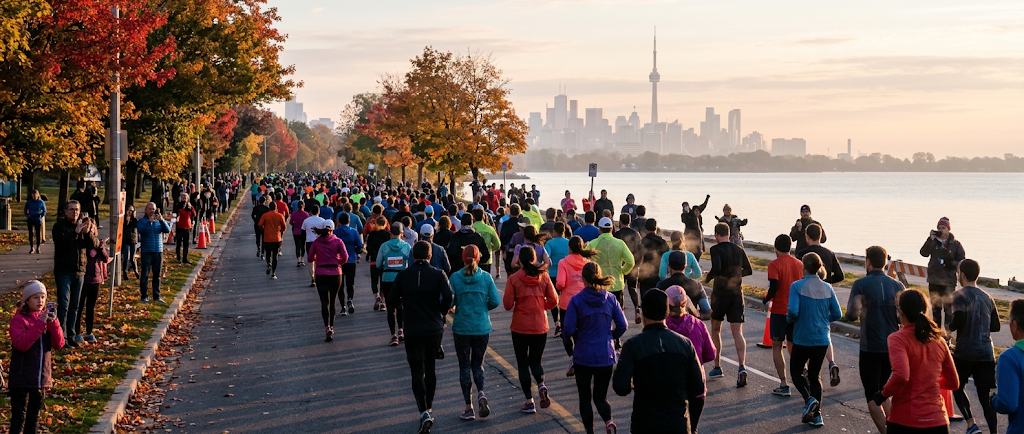
Toronto's October marathon along the lakeshore, with a half and a 5K, and one of the fastest courses in the country.
BMO Vancouver Marathon
Early May through Vancouver's neighbourhoods and Stanley Park, with a half and shorter events.
Vancouver Sun Run
A 10K in April that fills downtown Vancouver - one of the biggest 10Ks in North America.
Around the Bay
Hamilton's 30K road race in spring, older than the Boston Marathon and a classic tune-up for spring marathons.
Royal Victoria Marathon
October in Canada's mildest city, along the waterfront and through Oak Bay.
The Trail Racing Scene in Canada
Squamish 50 (BC)
Fifty miles and 50 km in the Coast Mountains in August, with a two-day 50/50 for the very keen.
Fat Dog 120 (BC)
A 120-mile mountain ultra in Manning Park and the Cascades, one of the hardest races in the country.
Sinister 7 Ultra (Alberta)
A 100-mile, seven-leg race in the Crowsnest Pass in July, run solo or as a relay team.
Canadian Death Race (Alberta)
A 118 km mountain race around Grande Cache in early August, also solo or relay.
Ultra-Trail Harricana (Quebec)
Quebec's biggest trail festival, in the Charlevoix mountains each September, from 10 km to 125 km.
Knee Knackering North Shore Trail Run (BC)
A brutal 50 km traverse of Vancouver's North Shore mountains in July.
5 Peaks series
Short, friendly trail races across BC, Alberta and Ontario, with a "sport" and an "enduro" course at each - the easiest way into trail racing.
Which Is Right for You?
Choose road if you like predictable footing, chasing a time, big crowds and easy logistics. Choose trail if you like being in the woods and mountains, don't mind walking the climbs, and care more about the experience than the clock.
Can You Do Both?
Absolutely - and each helps the other.
How road helps trail
Road running builds the aerobic base and the leg speed that make the flatter parts of a trail race comfortable.
How trail helps road
Trails build strength in your legs, ankles and core, and the softer surfaces give your joints a break from pavement. Many road marathoners do some of their easy running on trails for exactly that reason.
Ready to find a race?
Browse trail runs, ultras and road half marathons across Canada.