In This Guide
- Choosing Your First Distance
- Finding a Race
- Registration & Entry
- Training Basics
- What to Wear & Bring
- Race Day Tips
- Running Through Canadian Weather
- After the Race
Your first race is mostly about getting to the start line feeling ready and finishing wanting to do another one. This guide covers the decisions that matter, from picking a distance to what to wear when it's -5°C at the start.
1. Choosing Your First Distance
The most common beginner mistake is choosing a race that is too far for your current fitness. Starting short is not a compromise: a good first experience is what turns one race into a habit.
parkrun: the easiest start
If you have never done an organised run, start with parkrun: a free, timed 5 km held every Saturday morning in 69 parks across Canada, from Nose Hill in Calgary to Clover Point in Victoria and the Beach Strip in Hamilton. You register once online, bring your barcode, and turn up. Walkers, runners pushing strollers and fast club runners all take part, and nobody finishes last - a volunteer tail walker does.
parkrun teaches you the basics of racing - lining up, pacing yourself, crossing a finish line - without an entry fee or a commitment.
5K races and fun runs
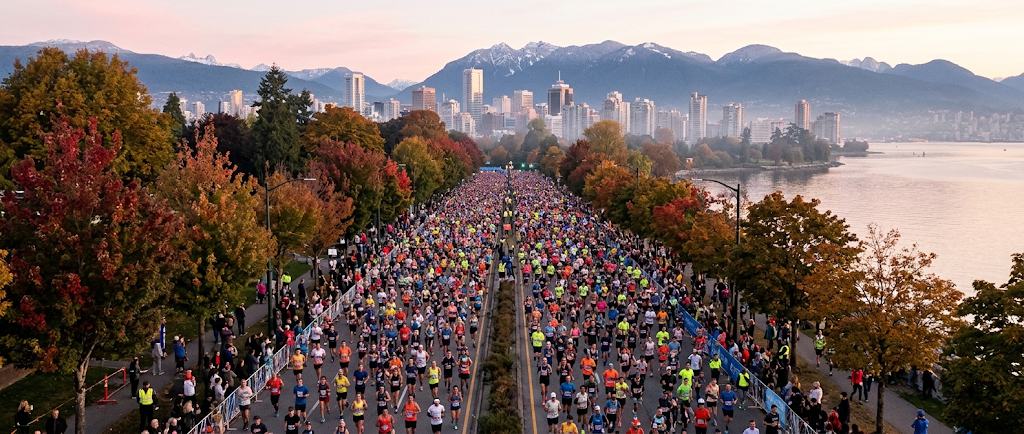
Once you can cover 5 km, whether running, jogging or mixing in walk breaks, you are ready for a 5K race. Most big race weekends include one: Tamarack Ottawa Race Weekend in May, the BMO Vancouver Marathon weekend and the TCS Toronto Waterfront Marathon in October all have 5K events with thousands of first-timers. Charity runs and themed events (Santa runs in December, Halloween runs, colour and foam runs) are even more relaxed.
If 5 km feels like a stretch, look for events with a 1 km, 2 km or 3 km option - many community runs have one.
2. Finding a Race
Canada has races almost every weekend from April to October, and a smaller winter calendar of halves, snow runs and indoor events. For a first race, look for:
- Close to home - less travel, less stress
- A flat course - save hills for later; waterfront and river-path courses are usually flattest
- A big field - larger events tend to be well organised and have more people at your pace
- Comfortable weather - late spring and early fall avoid both winter cold and summer humidity
You can browse every upcoming race on RacesCanada by province, city, distance and month, and save races to your own calendar.
3. Registration & Entry
Almost every Canadian race takes entries online. Many use Race Roster; others use Running Room, Zone4, Sportstats, UltraSignup (trail and ultra races) or MS1 (common in Quebec). Expect to:
- Register early - popular races sell out, and most have early-bird prices that rise closer to race day.
- Pay an entry fee - roughly $25 to $60 for a 5K, more for longer distances and big-city events. A service fee is often added at checkout.
- Pick up your race kit - bib, timing chip (often stuck to the back of the bib) and sometimes a shirt. Kit pickup is usually the day before, sometimes on race morning.
- Check transfer and deferral rules - many races let you transfer your entry or defer to next year for a fee if your plans change.
4. Training Basics
Couch to 5K
If you are starting from little or no running, a Couch to 5K-style plan takes 8 to 9 weeks of three short sessions a week, building from run-walk intervals to 30 minutes of continuous running. Running Room stores across the country also run beginner clinics.
A rough timeline
- 5K: 6-8 weeks if you can already run 10-15 minutes
- 10K: 8-10 weeks from a comfortable 5K
- Half marathon: 12-16 weeks from a comfortable 10K
- Marathon: 16-20 weeks, ideally after at least one half
Key principles
- Most of your running should be easy - slow enough to hold a conversation.
- Increase gradually - add no more than about 10% a week to your total.
- Rest matters - adaptation happens on rest days; two or three runs a week is plenty to start.
- Be consistent - three easy runs every week beat one heroic run a fortnight.
RacesCanada's free training plans build a plan to your race date from 5K to marathon.
5. What to Wear & Bring
Shoes
Get fitted at a running store if you can. Comfortable, broken-in shoes matter more than any brand. Never race in brand-new shoes.
Clothing
Wear technical (non-cotton) fabric that moves sweat away from your skin, and nothing new on race day. In cool weather, dress as if it is about 10°C warmer than the start temperature: you will warm up within a kilometre. An old sweater or garbage bag you can throw away at the start keeps you warm while you wait.
What to bring
- Your bib and safety pins (or a race belt)
- A watch or phone if you want to track your pace
- Water and a small snack for before the start
- Warm layers and dry clothes for afterwards
- Anti-chafe balm for longer races
6. Race Day Tips
Before the start
- Arrive early - allow time for parking, washroom lines (they get long) and bag check.
- Eat something familiar 2-3 hours before: toast, a bagel or oatmeal.
- Warm up with 5-10 minutes of easy jogging for shorter races.
- Line up honestly - start near runners of your pace; many races have pace signs or corrals.
During the race
- Start slower than you think - adrenaline makes the first kilometre feel easy. Ease in and finish strong.
- Use the aid stations - walk through them if you like; it's normal.
- Walk if you need to - plenty of runners walk at times, and walk breaks are a strategy, not a failure.
- Enjoy it - thank the volunteers and take in the crowd.
7. Running Through Canadian Weather
Cold
Winter races are part of the Canadian calendar. Layer up (base layer, light insulating layer, wind shell), cover hands, ears and head, and watch footing on snow and ice - trail shoes or traction cleats help. Wind chill at the start matters more than the thermometer.
Heat and humidity
Summer in Ontario and Quebec can be hot and humid. Slow your pace in the heat, drink before you are thirsty, and wear a cap and sunscreen. Morning races avoid the worst of it.
Trails and wildlife
On trails, carry water, know the course markings, and follow the organiser's advice on wildlife: some routes are in bear country, and ticks are common in long grass from spring to fall - check yourself afterwards.
8. After the Race
Cool down
Walk for 5-10 minutes after you finish, then stretch gently.
Refuel
Eat and drink within an hour - most races have food at the finish.
Recover
Expect sore legs for a day or two. Rest or walk; a good rule is one easy day for every kilometre raced before you race hard again.
Plan the next one
Many runners book their next race before the medal has cooled. A 10K or a half marathon is a natural next step - or simply the same race next year, faster.